Most AI-generated product prototypes look surprisingly similar. Whether they came from v0, Claude, Lovable, or another tool, the patterns repeat: the same layouts, the same interactions, the same assumptions about how software should work.
That sameness is more than visual. The user experience is generic too.
A common story we’re hearing in recent sales conversations is how a single founder has put a working prototype together by leveraging AI, but it just “isn’t quite what they want it to be” and they need help to give it the polish they think it needs.
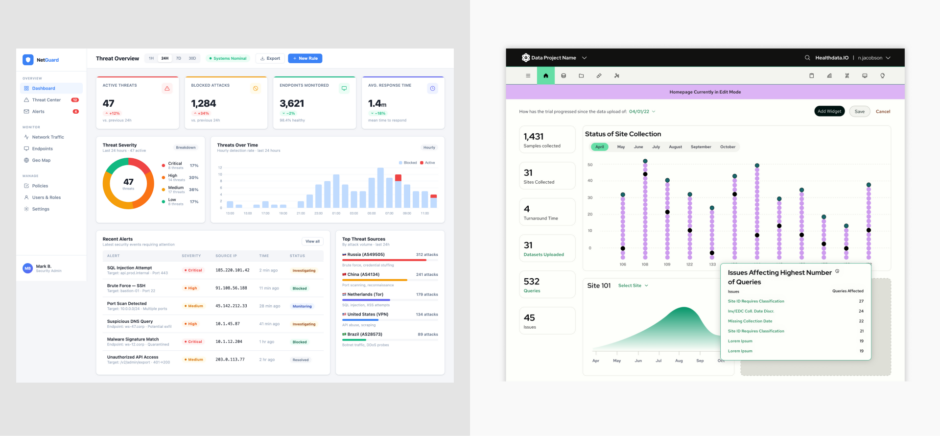
AI tools are excellent at generating broadly familiar interfaces, but they struggle with the details that make products genuinely useful: workflows tailored to your users, interactions shaped around your data, and navigation structures that hold up as complexity increases. A generated dashboard may look polished, but it rarely reflects the realities of your business or the way your users actually work.
And the deeper you go into a prototype, the more these gaps tend to appear. Key screens may feel strong, but edge cases, error handling, navigation depth, and workflow cohesion often break down quickly.
That’s the last mile — and it’s where most products are less finished than they appear.
The Perception Gap
The biggest challenge isn’t usually the prototype itself. It’s the perception of how complete it is.
Teams often believe they’re 95% done because the product looks real and functions at a surface level. In practice, the remaining gap is much larger. What appears to be “just polish” is often a combination of usability issues, incomplete interaction design, inconsistent workflows, missing states, and lack of engineering readiness.
Bridging that gap is often half the work.
What We Consistently Find
At Fuzzy Math, we evaluate AI-generated prototypes using UX heuristics covering navigation, interaction patterns, forms, error prevention, and trust and credibility.
The same issues appear repeatedly:
– Navigation structures that are too shallow or inconsistent for the complexity of the product
– Weak error handling and recovery states
– Experiences that lose cohesion deeper in the workflow
– Interfaces that technically work but don’t feel trustworthy or intentional
Trust and credibility are especially important. Users can immediately sense when a product feels generic or unfinished, even if they can’t explain why. Speed of creation doesn’t matter if the final experience doesn’t feel credible.
AI Is Powerful — But It’s Not the Whole Process
AI tools are incredibly valuable early in product development. They accelerate ideation, help teams explore workflows, test assumptions, and quickly visualize concepts.
The better the discovery work going in, the better the generated output.
But AI works best as part of the process, not the entire process.
What we offer is the handoff: you use AI to move faster toward a strong prototype, then we help turn it into a cohesive, differentiated, production-ready product. Depending on the tool and file structure, we can often work directly within what you’ve already created — refining UX, strengthening interaction patterns, and building the visual and structural systems needed to scale.
The Final Gap Is Often Visual Design
A significant portion of the remaining work is visual design and systems thinking.
Design systems, interaction consistency, hierarchy, motion, spacing, typography, and brand expression are what transform a generated interface into a product that feels intentional and commercially ready.
That final layer is still difficult for AI tools to produce consistently. It requires judgment, context, and craft.
Doing something unexpected or pushing the boundaries of the brand guidelines or design system is still best delivered by humans.
Who This Is For
This is for product leaders, founders, and technical teams who have used AI to accelerate product design but feel like something is still missing.
Maybe the experience lacks depth. Maybe the workflows feel fragile. Maybe the interface looks polished but not differentiated. Or maybe the prototype simply isn’t ready to hand to engineering.
That’s the gap we help close.
Let Fuzzy Math Be Your Last Mile
Fuzzy Math is a UX and product design consultancy with decades of experience designing enterprise and consumer software for companies including Microsoft, GE Healthcare, and KPMG.
We help teams evaluate, refine, and complete AI-generated products by improving usability, strengthening workflows, building scalable design systems, and preparing products for engineering handoff.
AI can get you surprisingly far.
We help get you the rest of the way.
__________
Let’s design your path forward.
Schedule a conversation with Fuzzy Math to explore how digital strategy, UX, and clear roadmaps can unlock better outcomes for your organization.