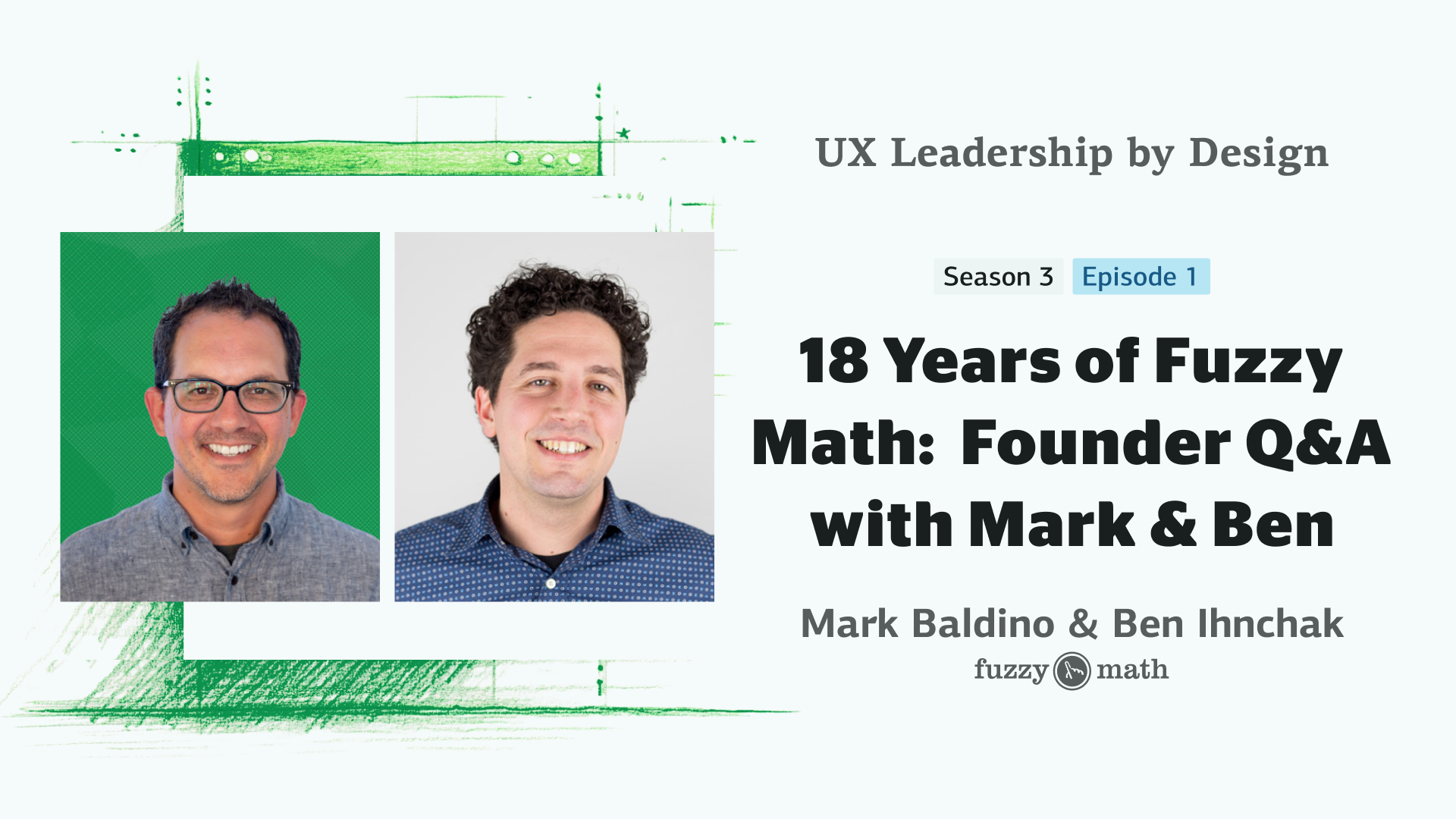
In this special Season 3 premiere of UX Leadership by Design, Fuzzy Math co-founders Mark Baldino and Ben Ihnchak sit down live with their team for a candid Q&A reflecting on nearly 18 years of building a UX consultancy. From stakeholder management and work-life balance to founding lessons and company culture, the two share honest insights on what it really takes to lead and grow a design firm. Whether you’re a UX leader, aspiring founder, or design professional, this episode is packed with real-world wisdom from two people who’ve lived it.
Listen & Watch
- Apple Podcasts: https://podcasts.apple.com/us/podcast/18-years-of-fuzzy-math-founder-q-a-with-mark-ben/id1658851404?i=1000755766725
- Spotify Podcasts: https://open.spotify.com/episode/7vBLVxJd0GXdhB7OBltNer
- Watch on YouTube: https://www.youtube.com/watch?v=CeXb-QdOLuA
Key Takeaways
- Trust is the foundation of a lasting co-founder relationship
- Selling on relationships and outcomes matters more than selling on process
- Helping people grow in their careers is one of the most rewarding parts of running a firm
- Work-life balance looks different for everyone — knowing your priorities is what matters
- Transitioning from founder-led to a leadership team model is a game changer
- Stakeholder management is both the hardest and most rewarding part of consulting
- Culture doesn’t disappear when you go remote — it just requires more intention
- You don’t have to be passionate about every part of running a business to be great at it
Resources & Links
Chapters
- 00:00 — Welcome & Intro: A Special Live Season 3 Premiere
- 01:00 — Introducing Ben Ihnchak: 18 Years of Fuzzy Math
- 02:24 — What Would Surprise You About Your Co-Founder?
- 05:10 — Advice We Wish We Had When Starting Out
- 09:28 — Work-Life Balance as a Founder & Parent
- 14:34 — Biggest Accomplishments & Milestones at Fuzzy Math
- 19:15 — Misconceptions About UX & Stakeholder Challenges
- 27:37 — How Fuzzy Math Started & What We’ve Learned
- 42:24 — Audience Q&A & Closing Thoughts
Tags
#UXLeadership #UXConsultancy #DesignFirmFounders #StakeholderManagement #WorkLifeBalance #UXCareer #BuildingADesignTeam #RemoteWorkCulture #UXStrategy #DesignLeadership #CoFounders #B2BUXD #EnterpriseUX #HumanCenteredDesign #UXPodcast
Transcript
Mark Baldino (00:01.656)
Hello and welcome to UX Leadership by Design. I'm your host, Mark Baldino. And as you can see, we a very special episode. I had a lot of special episodes recently, but this one, I'm actually in person with fellow Fuzzy Math co-founder, Ben Inczek. And we're here actually in Chicago and we had a Fuzzy Math on site for the past few days. And as part of wrapping up our final day, the team has submitted questions. And so we're actually...

Ben Ihnchak (00:01.902)
Hello and welcome to UX Leadership by Design. I'm your host, Mark Baldino. And as you can see, we have a very special episode. I a lot of special episodes recently. But this one, I'm actually in person with fellow Fuzzy Math co-founder, Ben Pacheck. And we're here actually in Chicago. And we had a Fuzzy Math on site for the past few days. And as part of wrapping up our final day, the team has submitted.

questions and so we're actually recording live in front of a studio audience.

Mark Baldino (00:29.654)
recording live in front of a studio audience. Which is both pretty fun. And I think for Ben and I slightly nerve wracking. So that's going to be the format. We're going to bounce some questions back and forth. Some for me, some for Ben and some for both of us. But I appreciate folks for continual listenership of the podcast. If you liked this episode, I encourage you to like and share on all the social

Ben Ihnchak (00:41.678)
So that's going be the format. We're going to bounce some questions back and forth. Some for me, some for Ben, some for both of us.

Ben Ihnchak (01:00.334)
that you utilize. So, Ben, I actually know how many episodes of UX Leadership I designed you've listened to. can say all of them, but what I always ask people to do is give themselves a little bit of an introduction. So, you can introduce yourself to the audience. That'd be fantastic. Yeah, I'm Ben Inchik. I have been working with Mark for, I want to say, almost 19 years and almost 17 of those at Fuzzy Math. That is a little less than half my life, been working with Mark. Really quick background.

Mark Baldino (01:00.382)
that you utilize. So Ben, I don't actually know how many episodes of UX Leadership by Design you've listened to, you can say all of them, but what I always ask people to do is give themselves a little bit of an introduction. So if you can introduce yourself to the audience, that'd be fantastic.

Mark Baldino (01:22.104)
God bless you. I'm a little less than half my height. work. Really back in the 90s. I to the startup, got into high school, a couple friends of mine, my sister, pulled up older. There was like a doc team group. They wanted to start a monster. We started selling stuff that we hid ourselves in. paperworks, inkle guns, music. Kind of solved both with software development and software design. Went to school for computer science.

Ben Ihnchak (01:29.55)
I worked at a startup when I was in high school. Couple friends of my sister's a little bit older. It was like the dot-com boom. They wanted to start selling stuff that we did ourselves, skateboards, paintball guns, music. Kind of fell in love with software development, like software design. Went to school for computer science, went to grad school for human-computer interaction, was a fancy word for UX. And then I worked as a backend developer, eventually met Mark. And that was like 19 years ago. was wild.

Mark Baldino (01:49.112)
That is the short version, but probably what folks who are listening to the podcast are happy with. could go into all the details and we are in terms of these questions. So why don't we have like a handful of questions from the team, which is pretty exciting. And Ben and I haven't read them, so we're going to both, I'm going to read them live and then.

We're going to kind of go from there and then we might open it up to some additional follow-ups from the fuzzy mathers that are in the room. Okay, Ben, here's a question of what would people be surprised to learn about your co-founder? So what would be people surprised to learn about me?

Ben Ihnchak (02:24.702)
Okay, then. Here's question. What would people be surprised to learn about your co-founder? So what would people be to learn about? Man, that is a tough one to start with. What would people... man, don't know. Mark's one of the handiest people I know.

Mark Baldino (02:48.152)
the people I

Ben Ihnchak (02:52.268)
has very strong opinions about Italian food.

Mark Baldino (02:54.968)
You

Ben Ihnchak (02:58.38)
What else? Man, this is, I should have cheated and looked at the questions.

Mark Baldino (02:59.35)
Man, this is, I shouldn't needed the questions.

Ben Ihnchak (03:06.786)
I thought like the amount of like family time, Mark, like Mark is a very large family. I don't know if that's come up in the podcast or not. but then like family time and how important family is to Mark and big family. all that stuff is not the, the work side of things. Maybe that's it. Mark and I are very different. This is, we're just rolling with it. Mark and I really different. I bring myself to work. Mark is work work. And then real life Mark are two different things. I think that's really interesting.

Mark Baldino (03:14.387)
But then I would say that our whole family is Mark. He's a big family. All that is not the works that have been created. Mark and I worked together for this, we're just rolling with it. Mark and I have worked together. I've put myself to work. Mark is work, work, and then real life Mark is doing the same. I think that's really a good thing. I think that's a whole separate Mark that people don't hear because of

Ben Ihnchak (03:35.712)
And I think, so almost, that divide, like there's a whole separate mark that people don't really see at Fuzzy Math. I think it's super interesting. Well, that is interesting. hope it's definitely true. Okay, so for Ben, he's a proud co-founder. I think Ben is like incredibly dedicated.

Mark Baldino (03:44.909)
Well, thank you. That's, that is interesting in a whole, that's definitely true. Okay. So the, Ben, what would people be surprised to learn about your co-founder? I think Ben is like, incredibly dedicated towards what he does and can be really single-minded at times, but with competing initiatives. like right now Ben is in a pretty.

Ben Ihnchak (04:02.382)
towards what he does and can be really single minded at times but with competing initiatives. like right now, is pretty, I don't know if right, but as you are training a lot, you are like solely dedicated to it. the case of kind of your like the past few years and like you're in it and you're driven and Ben does this interesting thing, I think, on projects.

Mark Baldino (04:13.664)
I don't, I don't know what the right word is. are, training a lot and you are like solely dedicated. That's a new phase of kind of your life for past few years. And like you're in it and like driven and Ben does the same thing. I think on projects, he's very focused and driven to deliver a specific project. And he gets very into that mode. he's in the mode of a founder at times and very dedicated to making that work.

Ben Ihnchak (04:29.87)
He's very focused and driven. River's a big project. He's very in that mode. He's in the mode of founder at times, very dedicated to making that work and pushing those people around him. I think, I know if it's surprise to work with him, that kind of comes off a little bit laid back.

Mark Baldino (04:42.814)
and pushing those people around him. I think, I don't know if it shouldn't be a surprise for people that have worked with him, but Ben kind of comes off as a little bit like laid back. He's got a good sense of humor, but like he's, he can be pretty intense. And those things are like multiple phases of life that are intense at the same time. And his dedication is pretty impressive. So, okay.

Ben Ihnchak (04:53.198)
I've got a good sense of humor, but like he can be pretty intense and those things quite multiple phases of flight that are intense at the same time and his dedication is pretty impressive.

Okay.

Yeah. Maybe I'll go first. I'll ask a question. If you could go back and give me one piece of advice for this party. This is a good one. So what advice would I could have gotten when we started?

Mark Baldino (05:10.328)
Ben, maybe I'll go first, but I'll ask a question. If you could go back and give yourself one piece of advice when starting out, what would it be? mean, this is a good one. This is a question. So what advice would I could have gotten when we started out and what would it have been? I kind of joke that no one really gave me any advice. was pretty, I feel like I live a very privileged life. I started a company.

Ben Ihnchak (05:27.342)
I kind of joke that no one really me any advice. I was pretty, I feel like I really look very privileged to life. I started a company with Ben, one additional founder at the start. no one said we were crazy and no one told us we shouldn't do it. And think a lot of other people that try to start businesses, everyone's just playing in their face why they shouldn't do it and assume it's gonna fail. And we need to get fortunate.

Mark Baldino (05:36.684)
with Ben with one additional founder at the start. like, no one said we were crazy and no one told us we shouldn't do it. And I think a lot of other people that try to start businesses, everyone's just putting it in their face why they shouldn't do it and assume it's going to fail. And we didn't get that. We're fortunate. That's not necessarily a piece of advice. the one, one piece of advice that, that I would, I would probably like to have received is that I don't think you

Ben Ihnchak (06:03.446)
I don't think you have that. I think mixing financial and what you do for work.

Mark Baldino (06:06.296)
I believe this. I don't think, but it took me a while to learn. don't think you have to, um, I think mixing like financials and what you do for work and like passion, I think is a double edged sword. And I don't think you need to try to balance those two. I think in fact, Ben mentioned, I do stuff around the house. I try to be handy. Like I think if I tried to make a living off of that, it would bring me a lot less joy. And actually these days, I think I need a separation between those two.

Ben Ihnchak (06:16.718)
and like passion, I think it's a double-edged sword. I don't think you can try to balance those two. I think in fact, I do stuff around the house, I try to be handy. I think if I try to be an awful pedophile, I'll destroy it. And actually these days, do separation between those two. So not feeling like, I think early on.

Mark Baldino (06:35.64)
So not feeling like, think early on, I sort of felt like this had to be the thing I was the most passionate about, had to love everything about running a business. Like it's hard. And it's not that I, I mean, you need to like your job, especially the one that you're getting paid for. Certainly if you can find an overlap and you love it and it's your passion, but I think that's really, really hard. So I just think advice would be like, it's okay to have those two be a little bit, a little bit separate. So Ben, what do you think is a piece of advice you wish you had gotten?

Ben Ihnchak (06:37.834)
man, there's a...

Mark Baldino (07:03.0)
Sorry. So if you go back and give yourself one piece of advice, I misread the question, but I think I still answered it. Does that change it at all?

Ben Ihnchak (07:08.276)
I think the funny one is, you know, don't have kids at a certain point in your life. that was hard. yeah, I don't know. It's actually, I'm going to kind of riff off marks. think there's, I'm probably in the camp of find something you really like doing and find a way to make money off that. But I think what fuzzy math is and what we do.

Mark Baldino (07:14.136)
is.

Mark Baldino (07:20.726)
Yeah, I don't

Mark Baldino (07:24.408)
Third.

Mark Baldino (07:28.536)
really like and finally, but I think what there's parts of it that I truly enjoy but think that's really part of my life. I kind of like people a lot. like talking about fun and like seeing like working with people is great but I don't watching people

Ben Ihnchak (07:36.546)
There's parts of it like I truly deeply enjoy, but I think that's just like, that would be part of my life, no matter what I do. I kind of like people, certain people a lot. I like the people I'm surrounded by at Fuzzamath a ton and like staying, like working with people is great. I don't know, watching people grow is really, really interesting to me. Like seeing people, we've had multiple examples of people coming through the door as interns.

Mark Baldino (07:56.312)
is really, really interesting to me. Like seeing people, you've had whole examples of people coming through the door as if they're super fresh out of school and they're watching them grow in their careers is really, really interesting to me. I don't know what it why I said I could give myself to that, but you pay more attention to that early on.

Ben Ihnchak (08:06.062)
super fresh out of school and then watching them grow in their career is really, really interesting to me. I don't know what advice I could give myself to that, but I think we pay more attention to that early on. And like, if you capture that and like help other people succeed, they stick around for a really long time. I think we did that, but we weren't doing it like intentionally early. I think the earlier we got onto that, the like the easier things would be, you know.

Mark Baldino (08:16.952)
And like if you're casted as that and like some other people have seen it around for really long time. I think we did that, but we weren't doing it like intentionally early. I think the earlier we got off of that, the easier it would be, know, trusting other people could surely be something that would be helpful for me. Things like that.

Ben Ihnchak (08:32.814)
trusting other people could surely be something that would be helpful for me. Things like that. I didn't know what I was doing when we started the company. was young. Nobody was saying that's a good idea or a bad idea. There was just people looking at me surprised, like, all right, whatever. And it worked out really well. But yeah, I don't know. I don't think we've made huge missteps. But I think learning to trust people little earlier in my life would have been easy or better.

Mark Baldino (08:40.408)
I don't know what I was doing all the time. didn't know. was there. But then you were there. knew there were people in the community who recognized you. And we were talking about it. But yeah, thought that was a good But I think learning about things a little bit was interesting. And neither of us said, start a business. Don't do consulting. Which I think some people have that answer. And I would have started Fuzzy Math over.

and maybe we've changed a few things along the way, it's been a good run for almost 17 years. So, okay, Ben, we're gonna stick with you. This is a question just for you. And it's related to something you mentioned with having a family and running a company. Do you have any hard rules surrounding work-life balance? Yeah. My superpower is I don't have to a lot. I, but I'm really good at by the hand.

Ben Ihnchak (09:11.458)
Yeah.

Ben Ihnchak (09:28.204)
Yeah. I do. My superpower is I don't have to sleep a lot. And I think that's one of the greatest gifts I have. like, this is like, I don't know, this is true. I'm a dad first. That's my first priority in life. I love my kids more than anything.

Mark Baldino (09:38.742)
I feel like this is putting this is true. I'm a dance person. That's my first priority in life. want to make years more than anything.

Ben Ihnchak (09:51.66)
They're very important to me. I think the way I am, I came from a family my dad died when I was young and he was sick from my early life. My kids are the single most important thing in my life and I do everything I can for them. That's priority one every single day. Two is I work. I'm a worker. I like working hard. I like putting everything I have into stuff and being really, really proud of it. And so everything I touch that has my name on it, whether that's Ben and check or fuzzy math.

Mark Baldino (09:51.736)
They're very important. I think the way I came, I came from a family my dad died when I was young, and he was sick from early life, and my kids are the single most important thing in life. And I do everything I can for my sobriety, every single day. Two is I work. I'm a worker. I work hard at putting everything in damage and stuff, and being really, really proud of it. That's what everything I've done so far is my job, whether that's managed, or fuzzy math.

Ben Ihnchak (10:17.39)
really care and I know it really drives people insane sometimes. I promise I'm working on it. And then three is like everything else in my life. Three is probably my wife. She's fantastic, amazing. We have a really good relationship and we've been together for like 25 years at this point. Fourth is exercise and then there's nothing else. Like that's my the entirety of my life. I don't really have hobbies. People say you exercise. It's not a hobby. It's like a compulsion. have to do it.

Mark Baldino (10:17.496)
really care and know it will be drastic for some times. I'm working on it. And then three is like, you know, She's probably my wife. She's fantastic. We've been in a really good relationship. We've been together for like 25 years at this point. Fourth is exercise and then nothing else. Like that's my entire deal. I don't really have copies.

people say, it's not happening. just compulsion. But that's like workplace balance is really every single day. And I love it. I love all sorts of things. I like to some fun at just the time. I do little thing like that. And I can do a little, you know, I've actually taken them. I don't think they're special. So like what I can do, like kind of expect them to love people and they're sometimes.

Ben Ihnchak (10:45.678)
But that's gonna it. that's like work-life balance is really, everything in my life falls down that priority scale. And I love it. I love all four of those things. And it's, like, you know, I have some rough edges at times about like what Mark was saying earlier. I can get a little single-minded and I can get a little, you know, I have expectations and I don't think I'm special. So like what I can do, I kind of expect out of other people, which isn't fair sometimes. Cause I'm older, I've done it more than they have.

Mark Baldino (11:10.682)
Right on. Thanks, Ben.

Ben Ihnchak (11:13.774)
I'm surrounded by incredibly talented people here and, priority and, you know, work-life balances. It's just, could sleep less, but everything follows through that, you one to four, priority list every single day.

Mark Baldino (11:30.06)
You're supposed ask me this question, but I'm gonna ask myself since you have the questions in front of you. So this is just for me. What was an idea or quote rule unquote you had when you started out building your business that turned out to be not realistic or as important to keep as you thought starting out?

Ben Ihnchak (11:30.103)
useful set.

Mark Baldino (11:47.692)
I had this conversation in Toronto two weeks ago with a client. I tend to be pretty process oriented and or process depending on what part of North America you're in. And, and so when we first started, I was like, well, what's our, what's our process? What's our process? And I spent, I don't know how many decks I have selling like that described process and different ways to do what we do. And at the time, mean, truthfully, like,

Ben Ihnchak (11:47.758)
had this conversation in Toronto, Mexico, and I think it a process right, and the process and the management. And so, we first started out,

Ben Ihnchak (12:10.493)
And at the time, mean, truthfully, like, when we started working on the other numbers, was kind of the last thing.

Mark Baldino (12:15.512)
When we started Fuzzy Math in it was kind of the last down economy and the housing crisis. so we were just starting kind of like not a great economy and we were actually starting a company doing UX and people weren't really talking about UX that much. We had an honest debate as to whether we should call ourselves a UX consultancy. And actually I think we bounced from like product strategy, digital product strategy, which is interesting because now that term is back and being used a lot.

Ben Ihnchak (12:23.13)
So we were just starting out of a great economy and we were actually a company doing UX and people weren't really talking about us that much. We had a positive data point of view that we should call ourselves a UX consultancy. And actually, I think we've gone from a product strategy to a product strategy which is just about as back-ending as a lot. We started with UX. I will obsess with what's our process and how it's evolved in the process.

Mark Baldino (12:44.148)
But we stuck with UX. I was like, I was obsessed with what's our process and how to sell on process. And what I've learned is, or that was sort of a rule I thought, because I'm not a salesperson, I'm a designer and I want to follow a process, is that it's not, you know, it's easy to say it's outcomes, but that you should be selling on and not process. But I think clients only, a very small percentage of clients care about process. And I think if you describe it,

Ben Ihnchak (12:51.214)
it is for what I call a process. I'm not a salesperson, because I am a lot of color in the process. It's easy to get to options, but that you should be selling at a processed point. I think clients own a very small percentage of clients' care off of a process. And I think if you describe it in a half a slide, where they know you have it, where you build up credibility, and where you have to talk about it, it is about options. It's about what you've done, but actually it's really different.

Mark Baldino (13:11.52)
in a half a slide, or they know you have it, or you built on some credibility and don't really have to talk about it. It is about outcomes. It's about what you've done, but actually it's really the relationship, which is something I think also is one of Ben's superpowers is establishing relationships short and long-term with folks who work for Fuzzy Meth and with our clients. And that's all about relationship building. And if you are selling to somebody who's really process oriented, we can do it because we have it, but it's probably not like a great long-term client.

Ben Ihnchak (13:29.41)
Thank you.

Mark Baldino (13:39.202)
But if we can find people who are looking to establish a relationship with us, who want to invest in our people, and we want to invest in their company, like that's what we should be selling on. So process matters. I think sometimes as designers, we get a little dogmatic about it because we see the chaos around us in organizations and we're like, we just, and I do this all the time. I have to apply a process to it to make sense of it, but it's really about understanding the humans that we're working with and building a relationship with them.

Ben Ihnchak (13:39.342)
We can find people who have a relationship with us, who want to invest in our people, who want to invest in the company. That's what we think is going on. So process matters. think sometimes as designer, get up talk about it, because we see the chaos around us in organizations. And we're like, oh, I do want to that. I have to learn to make sense of it. It's really a problem for the humans that we're working with and building a relationship with.

Mark Baldino (14:06.444)
which I think all of the team that's in the room here does an amazing job at. And that's what we should try to sell on, although it's kind of, it may sound like it's, you know, it's a sales tactic to sell on that, but really that's what we do. We build lasting relationships with our clients and that's really effective. And I didn't think that that was, I didn't even know to think in that regards early on. Okay. Ben, back to you, but this is a question for both of us.

Ben Ihnchak (14:06.446)
which I think all of the team in the room used to a piece of the job at. And I thought we should try this out. It may influence our business. You know, it's a sales tactic we've done on it, but really that's what we do. We build lasting relationship with our clients, and that's really effective. And I didn't think that that was, I didn't even know, think in that regard, we were going on. Okay, Ben, back to you. But this is a question for Alex.

Mark Baldino (14:34.716)
what accomplishment or milestone are you most proud of throughout your fuzzy math journey?

Ben Ihnchak (14:35.79)
Are you most proud throughout Fuzzy Math Church?

There's gonna be a theme. We had our like an alumni party on Monday and seeing people come back and there's a bunch of people that I stay in touch with even after you know, even after they've left. Generally, when somebody's leaving Fuzzy Math, they contact me and they tell me about it first and that's part of the deal. And then we're still like just seeing people come back and having good relationships with the people that have worked here that we you know, I don't think this is an easy job.

Mark Baldino (14:48.501)
and we'll come back.

Mark Baldino (15:03.108)
Thank you. Like just seeing people come back to relationships with the people that have worked here that we know. I don't think this is an easy job. I don't think anybody excruces because it's like, it's gonna be super simple. You know, like punch in, punch out, you know, your face back. And so this gets hard.

Ben Ihnchak (15:12.622)
I don't think anybody chooses because it's like, oh, this is going be super simple. like, know, like punch in, punch out and like, you know, get your paycheck. And so it's hard and like we can have disagreements and we can argue and differences of opinions and strong opinions in every direction. And we still have really good relationships with people that left years ago. And like a decade ago, somebody came back just to like hang out with us and get pizza. I think that's, that's super cool. It's not like, um,

Mark Baldino (15:22.552)
and we can argue with differences of opinion and strong opinions in every direction and we still have relationships with each other. years ago, actually, we both made that decision and have a relationship with So I think that's super cool. It's not like, I don't want to say this politically. The confidence in most part of the campaign is from the people who using it.

Ben Ihnchak (15:39.926)
I want to say this politically. The accomplishments that I'm most proud of aren't like project work. I love designing stuff that's super fun. Learning about businesses and our clients, the challenges we face is super, super enjoyable and I love it. But that's not what I'm to be thinking about in my deathbed. It's going to be like the reputation we've built, how people have thought about me. The, you know, if I needed help, I think I could reach out to a bunch of people that are like work related people in my life and they'd probably help me out.

Mark Baldino (15:47.896)
Design is super fun. Learning about businesses and our clients and the channels, as we say, super, fun. But that's not what we think about it like that. So it's gonna be like the reputation build, how people would talk about the, you know, if I needed to talk about the internet, I about the people that are like, the people in our lives, how we can help people. I think that's

Ben Ihnchak (16:09.452)
I think that's truly meaningful to me and it matters.

Mark Baldino (16:14.036)
That is 100 % true. Accomplishment. mean, we've had a few, like when I think about the journey, there's a few that I'm proud that Ben and I like navigated through the first, like in year two, we had a founder who decided to go sort of switch careers and leave Fuzzy Math. And that was like horrifying because that person was doing a lot of sales and it was like, can we even keep this company going?

Ben Ihnchak (16:18.136)
So, you will.

Ben Ihnchak (16:40.782)
And we just want to come and serve the

Mark Baldino (16:40.822)
And we just like buckled down and service the clients that we had and started to hire staff that could help us. that was, that was, but that was a pretty big change because there was a chance really early on that the company just wouldn't exist. And we made a really big change during, obviously during COVID. mean, a bunch of companies did in terms of moving to remote.

But, this I think is less a credit to me and Ben and more to the team. Like we had to change our culture. And I talked to a few of the folks who were at the alumni event about it. Cause they, didn't even know we didn't have an office. So assumed we all worked together in Chicago, but like the connection between all fuzzy mathers at a period of time is really, really strong. And I don't, I think it was interesting that that person didn't notice that it felt like we were in a remote company. It felt, actually felt like we were connected. And so we kind of had a big culture shift.

Ben Ihnchak (17:07.822)
We had a few that worked together. One did be telling them, so assuming we don't work together in Chicago. the connectivity wasn't that much. The adage was really strong. I think it was interesting that that person didn't notice and felt like we were one company. Felt nice to work with. And so we had a bit of culture shift, which was what the culture was.

Mark Baldino (17:34.24)
which was what does culture mean and, in, in the age of a remote company and, that largely came from the team to figure that out. And I'm really proud that we are now a remote first company and can still get together and hang out. I think. Honestly, we deliver the same level quality of work in remote that we did when we were in person. and then most recently I'm, and this was one, but I'm giving three is like, we now run the company,

Ben Ihnchak (17:37.166)
It is an engagement company and that one thing we are continuing to do we are to have of of a drowsy crowd in the first place and get still together and hang out and I think honestly we deliver the same quality of work in Europe.

And then most recently, this is one the three, we now have a more public, we track dollar figures, leadership, so if folks that don't know, have head people and an ops now, that's the four, our head is a head four person leadership, make decisions together. It was founder, led, and we...

Mark Baldino (18:03.544)
kind of like more, more adult-like. We track dollars and figures. We have a leadership team. So for folks that don't know, we have a head of people and a head of ops now. That's the four, Ben and I are added to that and that's four person leadership team. make decisions together. It was a founder led and and really driven company for probably the first 13 years of Fuzzy Math.

Ben Ihnchak (18:24.398)
and really driven company for probably the first 13 years of fuzzing that. And it is to everybody with fuzzing that career and for their clients. It's to their benefit that it's not the case. We still make some bigger, higher levels strategic decisions, but really everything is done through leadership.

Mark Baldino (18:30.538)
And it is to everybody who works with fuzzy math, whether you're an employee or a client, it's to their benefit that that's not the case. We still make maybe some bigger, higher level strategic decisions, but really everything is run through, through a leadership group. and we just run it. I don't know how to say it. We run it more professionally and it feels a lot better. think it feels better to the team. And I think it feels better to, Ben and I, there's always a weight on the shoulder of, of founders.

Ben Ihnchak (18:47.438)
just on it with John and Alice. We run it more professionally and it feels a better to the team and I think it feels better to Ben and I. There's always a bunch of other founders, but I think the community and the way we think, running the business more seriously is a big shift.

Mark Baldino (18:59.544)
But I think having a leadership team and the way we take running the business more seriously is a big shift and I think a really positive one for the business.

Okay.

Ben, any misconceptions people have about the industry? no, I'll go first. Are there any misconceptions people have about the industry that you'd like to clear up? That we slow things down, I think is the single biggest misconception about designers. Cause we are always talking about research, research, research. So if you're in product management and you're listening to this, we don't want to slow things down. We want to do research cause we want to help you folks do your job more effectively.

Ben Ihnchak (19:15.5)
Yes.

Ben Ihnchak (19:19.758)
Are there any misconceptions? have nothing to do industry. I'd like to clear up on that. That we slow things down, I think it's a single business. Inception of entrepreneurs, because we are always talking about research, research. So if you're in a conflict, it was this, we don't want to things down. We want to do research because we want to help youth-loved students do their job more effectively. We are generally wanting to talk to the needs of our professors, and use the software we're

Mark Baldino (19:43.612)
we are generally wanting to talk to human beings because they're the people that need to use the software. We usually have a loose sense of a problem. And so we want to engage with people to better understand that problem and frame it and then start to put solutions out there. But all the people here is like, you're going to slow things down or we don't have time or energy for it, but it's really about building a solid foundation. and the misconception is that we're slowing things down, but actually in actuality and everybody here at Fuzzy Math, past, present.

Ben Ihnchak (19:48.942)
We usually have a loose sense of the problem, so we want to engage with people to better understand how we're going to frame it and the solutions out there. But all people here are thinking how we're going to talk about energy for it. But it's really about solid foundation. And the misconstruction that we've found that we're truly inaction-able and everybody's inaction-able, past, and future, will, after that, one day, be far ahead.

Mark Baldino (20:11.896)
and eventually future will know that when we are able to establish a better foundation, things are faster in the long run down, of further down the workstream thinking that go faster. So I think it's a misconception that like we demand research and we're going to slow everything down from a design perspective. But I will say in very, very few instances is design ever. actually, I mean, like getting to design and designing UI is a bottle.

Ben Ihnchak (20:23.454)
So I think we demand.

Ben Ihnchak (20:33.462)
I will say in very early stages, this design ever, actually getting Jupyter and designing UI is a bottleneck in processes. It's both actual framing of problems and training, because that's really hard. And so we kind of look at as a group that closes things down, but actually it's process. Speeds think up incredibly well.

Mark Baldino (20:41.184)
in processes. It's always in the initial framing of problems and understanding because that's what it's really hard. And so we kind of get looked at as a group that slows things down, but actually our process speeds things up incredibly.

Ben Ihnchak (20:58.542)
Do I get like a plus one answer? I don't know if I have anything. I don't know. I don't know if I have a strong opinion on this one.

Mark Baldino (20:58.616)
Do I get like, rule on it? Yeah, there's no rules. It's just two of us, man.

Mark Baldino (21:08.418)
Okay.

Mark Baldino (21:12.76)
All right. All right. All right. Well, then I'm going to give you a tough one. Ben, what are some recent challenges with stakeholders that you faced? We'll get the questions ahead of time.

Ben Ihnchak (21:15.416)
Perfect.

man, never had a challenging stakeholder. I, what is one? Over the years, some thematic issues I've wrestled with with stakeholders. Sometimes really large organizations, you know,

Mark Baldino (21:43.096)
You know, there's a lot of political, internal political stuff, and like outsiders, you know, as an outsider, I don't necessarily care about that, I care about like, doing the work and making the project a really good spot. And that can, that can kind of put us in a period of possession that we're making somebody look good or like, know, something else, or something else like that, or just internal politics at play that are kind of like, not my thing. And that can be difficult sometimes if you don't really know, know what's going on.

Ben Ihnchak (21:44.056)
There's a lot of internal political stuff and we're outsiders. as an outsider, I don't necessarily care about that. I care about doing the work and getting the project to really good spot. And that can put us in a weird position that we're making somebody look good or by doing something else, we're making somebody else look bad. And there's just internal politics at play that are not my thing. And that can be difficult at times if we don't really know what's going on internally.

If we're advocating for something too strong or too much or not enough or, you know, not supporting our, people that we're supposed to be supporting or should be supporting. Um, that can be a tricky one at big orgs. Um, small orgs can be the people that tell our stakeholders like, this is your, your idea. like, that thing is rough. And we're telling people their baby's kind of ugly and that's really hard. And you have to be delicate about that. Um, I personally struggle with, uh,

Mark Baldino (22:12.568)
If we're educated, we're not making strong money. We're not doing enough. We're not supporting our people that we're supposed to be supporting or truly supporting. That can be if we're going to dig ores. Small, we can be. There are people that can tell the person that they don't want to make, this is your, can put in like, ooh, this thing is rough. And we're telling people that they can tell. They make really hard money. That was a tough one. I personally struggle with.

Ben Ihnchak (22:42.22)
Stakeholders that are hiring us, but then also telling us what to do over they think of themselves as the like responsible for telling us what to do. Like, well, it should be this or like, you know, just go design that thing. We're, you know, we're independent people with independent thoughts and a process that brings ideas to the table. So if it's a different direction than what we're thinking of like, Hey, we did research and here's our ideas. And they're kind of like, no, just go do this thing instead. That's really hard for me.

Mark Baldino (22:42.25)
stakeholders that are hiring us, but then also telling us what to do, or they think of themselves as the responsible for telling us what to do. Like, well, it should be this, or just focus on everything. Where we're dependent people with different kind of thoughts and process and things like that to the table, so if there's a different direction, then what work?

thinking that we're getting pretty certain those are our ideas and they're kind like, just go do this instead. It's really hard for me. I think really hard for fuzzy man, people that are very smart, very intelligent, very narrow-minded view. And then just to come and feel like an extension of a stakeholder's form of them, you're just kind of like, you're in your

Ben Ihnchak (23:12.094)
really hard for FlesyMath, with people that are very smart, very intelligent, and bring their own point of view. And then just to kind of feel like we're an extension of a stakeholder's arm of them, you know, you're just kind of my team and you're gonna go do this thing, is tricky. I will say that's probably the most enjoyable part of projects for me. Like there is like, you know, recoiling and there can be friction at times.

Mark Baldino (23:25.992)
I will say that probably the most enjoyable part of the project for me, there's know, recoiling, reconstruction at times, but I think we're building that kind project and proving our work, explaining our ideas, and getting alignment is like the singular thing that I really love about the treatment.

Ben Ihnchak (23:39.95)
But I think working through those types of problems and proving ourselves, proving our worth, explaining our ideas, and getting alignment is like the singular thing that I really, really love doing, like the tricky people problems. It's not always smooth and it's not always perfect and we don't always succeed. But I do think those types of things are friction points with external leadership from fuzzy math. And it's like the challenge of what we do in our jobs. I like it.

Mark Baldino (23:53.652)
It's not a perfect model for me to succeed, but I do think those types of things are friction-coating. There's external factors composing that, and it's like a challenge for me to able to get on top. It's so interesting you say that, because I feel the same way. That challenge of stakeholder alignment is really interesting to me now, I enjoy it, and it's really rewarding. Neither of us...

Ben Ihnchak (24:18.798)
I don't do dis-

Mark Baldino (24:20.248)
do design anymore. Do you think it would be different if you're still in a role where you were like both, cause at some point Ben and I would like do everything except visual design, but it was like, so it was like sales, set up the account management, do the wire frame. Like, do you think it'd be different? You're like your enjoyment of stakeholder management if you were still doing design. Yeah. I have a look at our company, and I think we have an incredibly talented design team.

Ben Ihnchak (24:24.43)
at some point, do everything except visual design. But it was like, say, don't know, account management. Do the wire. Do you think it would be different if you're in drive-in state over now?

Yeah, I think I have a little bit more time to just focus on that. And I think we have a incredibly talented design team where sometimes the design is the easy part of the project, but that's just cause there's a team dedicated to it. And I think sometimes the leadership, the, know, stakeholder management is the hard part of the project or the easy part. I think having that, you know, division of labor from like,

Mark Baldino (24:47.736)
sometimes the design is easy part of the project, but that's just how those things are dedicated to it. I think sometimes the leadership, the stakeholder mix is the hard part of the project for the easy part. But I having that division of labor and so much more.

Ben Ihnchak (25:03.106)
our teams and our companies more mature now. So we have account leads and design leads and designers and PMs and everybody's kind of working together. And so the differentiation of role does make it a little bit more like I can attack this one problem, bigger, small and focus on it. And other people can take their problems and focus on those does make it more enjoyable.

Mark Baldino (25:03.414)
teams and our companies are a journey. the accountability, the design, the designers, PMs, and everybody's got work together. But differentiating the role does make it a little bit more like, I think there's one problem here, it's more focused on it, and other people are going take a little bit of focus and note, it does make it more enjoyable.

I would agree. So I was like, when I think of recent challenges, mean, my, I'm enjoying the stakeholder like alignment, but I mean, I recent challenges for me are like, not enjoying that too much, but like maybe it's stakeholder appeasement is what, it might look like from the outside, which is like listening to the client too much or advocating for the client too much. you know, there's a lot of financial pressure on a, on a firm of all sizes, but on a firm of our size. So when you have clients and it's this established relationship, like

Ben Ihnchak (25:23.534)
So I'm.

Ben Ihnchak (25:33.102)
Thank

listening to questions, and advocating.

Ben Ihnchak (25:47.161)
So, you have to establish your relationship. To Ben's point, how do you do that? They want us to be yes people. And we want to push back on that. that gets hard, personally, because I don't want to as good as we do with our clients.

Mark Baldino (25:51.212)
To Ben's point, like, how do you do that in a way where you're kind of pushing and pulling? They want to see us as strategic advisors. They don't want us to be sort of yes people. And we want to feel like we can push back on them, but that gets hard. And for me personally, it gets hard because I don't want to, I don't want to be seen as sort of like a squeaky wheel with our clients. And they actually kind of ask for both things. I speak from my perspective, which is like help support our team, but tell us when we're.

Ben Ihnchak (26:10.83)
I speak from my perspective, is like, help support our team outspent. And that's a really hard balance.

Mark Baldino (26:17.398)
And that's like a really hard balance. And I probably had not figured that out yet, even 25 years into my career. So my biggest, I mean, my biggest challenge is really like, how do you balance what Fuzzy Math needs? What Fuzzy Math team met? So Fuzzy Math is a business entity. How do you balance that with what the Fuzzy Math team needs? How do you balance that with the client as a business entity and the client stakeholders? Like it's pretty complex. And so I think it's a, always a good reminder for me. And when I have conversations with.

Ben Ihnchak (26:24.43)
So my biggest challenge is how do you balance fuzzy math, what? math team? That's the first question. In this entity, how do you balance the fuzzy math team needs, how do you balance the client entity, the fuzzy math team, and clients and coders? It's pretty complex. So I think it's always good to have a conversation with my project team, then we can sometimes just call it a

Mark Baldino (26:46.936)
project team or with Ben or even sometimes with the client of this reminder to like reset that relationship and make sure that, you know, I'm advising them on what they need versus like what they need to hear and sort of appeasing them. But it's really, I mean, it's really, it's really, really hard and it's complicated and it frankly, it should be complicated, but it's probably pretty big challenge.

Okay. I'm going to ask a few more questions with Ben. some point, I'm going to ask you for a question for me. That's not on the list. So, um, this is in the back. can, you're good multitasking. So, um, okay. This is a Ben only question. Can you share the aha moment that made you realize the market needed fuzzy math and what we provide? Do you have an answer for this?

Ben Ihnchak (27:12.064)
boy. god, Yeah, that- No! That's not what I meant.

Mark Baldino (27:37.905)
okay. I thought you'd be like, yeah, I got it.

Ben Ihnchak (27:40.694)
No, I know that I don't think that ever happened. I think the aha moment for me is I never liked having a boss. I was doing freelance stuff when I had my last full-time job. So I quit my job and I was like, I bet I could do this myself. you know, I had nothing planned. It was a horrible decision. It's a horrible way of running your life as a mid 20 year old. And it worked out really well. It had nothing to do with.

Mark Baldino (27:58.276)
I had a horrible decision.

Mark Baldino (28:04.76)
And it worked out. I had nothing to do with business school or like, there's a need for this. It purely like, I don't have my life's serum. I need to change something. I can tell you, it pretty revolutionary. Like, I my two days notice, and on the last day of work, I rode my bike home to clinic, I could go to Illinois City. I was crying, because I was just bawling at me. was like, hey kid, I need

Ben Ihnchak (28:07.042)
business school or like this is there's a need for this it was purely like I don't like my current life necessarily and I'm going to change something. I can tell the super short version of like I gave my two weeks notice my last day at work I was riding my bike home from Lincoln Lincolnwood Illinois into the city I was crying because I it was dawning on me like I don't have a paycheck I have nothing planned like this is a horrible decision at the time I was

Mark Baldino (28:30.2)
It's a real bad decision.

Ben Ihnchak (28:36.504)
So real bad. Real bad decision. I was at the corner of Kimball and Addison crying. My backpack buzzed. It was a phone call. The guy said, hey, I have some work. What are you doing? I was like, literally nothing. I just left my job, I have nothing planned. He's like, don't you come in on Monday? And then I met Mark that following Monday, and things worked out from there. So it was not like, hey, here's this market, and we can fit and do this. was like, I have a skill set, and I'm willing to work hard, and I bet I can do this myself. And then it, you know.

Mark Baldino (28:45.72)
The guy said, hey, I have some work. are you doing? I was like, it's literally nothing. I just left my job, and I had nothing planned. He said, why you coming on Monday? I thought I meant that following Monday, and it worked out from there. So it was not like, take it to the market, can fit into this. was like, I have a skill set, and I'm going to work hard, I'm going do this myself. And then the universal item, it worked out. But was absolutely horrible planning it. That's how it worked out for me.

Ben Ihnchak (29:06.466)
the universe aligned and it worked out, it was absolutely horrible planning and decision making. that's how it worked out for me.

Mark Baldino (29:14.712)
Right place, right time, and a lot of hard work, I think is, I think a lot of successes is like that. And that was certainly the case for me. So that was a Ben only question. This was a Mark only question, which is, kind of touched on, but how do you balance delivering immediate client needs with helping clients think through long-term business strategy? I mean, that is the crux of the issue. And so I used to have a diagram in like our company updates, which was like short-term over

Ben Ihnchak (29:35.31)
And so, we started.

Ben Ihnchak (29:41.39)
Short-term, short-term, emphasize client needs, long-term, emphasize like fuzzy math needs. But in this case, like immediate, long-term strategy, we have to deliver in this market, we have to deliver in the short-term. There's not a lot of good strategy projects. To be honest, once we've pitched over the past few years, it's been very, very hard to win. think we have one something, great process, great outcomes in terms of like getting there, building them.

Mark Baldino (29:44.32)
Emphasize client needs long-term emphasize like fuzzy math needs. but in this case, like immediate versus long-term strategy, you ha we have to deliver in this market. We have to deliver in the short term. There's not a lot of pure strategy projects. To be honest, like ones we've pitched over the past few years have been very, very hard to win. I think we have a great, we have won some and we've had a great process and outcomes in terms of like getting there and helping them, sell that sort of like long-term.

business strategy, but I, but it sounds, it's going to sound simple. I think for organizations, they're moving at speed and they want immediate impact. I think there's a lot of push on efficiency, given AI. So, you know, I've said this to the team a bunch of times, like product management is, and developers are out there using gen AI to give us wireframes or designs. And that's like a big change. There's this big push that like,

Ben Ihnchak (30:18.102)
I think for organizations that are moving at speed and they want immediate impact, I think there's a lot of pushing efficiency in AI. you know, I've spent this team much time with product managers, developers out there using AI to give us wider...

or to the mind, it's like a big change. There's this big push of like, UI is gonna slow things down. So we kinda have to, you know, you have to work on your code to sort establish things that the students you can analyze. And sometimes I feel like I'm something, too, it's like...

Mark Baldino (30:41.022)
UI is what's kind of slowing things down. So we kind of have to meet the immediate need. And then you have to work in parallel to sort of establish those strategic components. And sometimes that strategy isn't like business strategy. It's like doing research, right? So following the linear process of research and discovery and competitive and comparative analysis and synthesis, and let's do concepting and roadmap and then, okay, let's break it down into IA and then let's go wireframes and then visual design. Like that rarely happens these days.

Ben Ihnchak (30:51.48)
doing research, right? So following the linear process of research and discovery, competitive, comparative analysis, and synthesis, what's new concept roadmap, and okay, let's break it down into IA, let's go wireframe, and there's what you're about. That really, happens these days. So instead, we need to do in some incremental work to show, frankly, how good that can be.

Mark Baldino (31:10.23)
So instead it's, we need to do some incremental work to show frankly value and that we can move at pace and speed. And that's the immediate need while doing things in parallel, which are the development of the business strategy. And I think for that, it's a lot about understanding what the business strategy is and what those metrics and numbers are and then how we can align our work. But I think it's just, I just don't think it's, I don't.

Ben Ihnchak (31:16.174)
pace and speed, and that's the ability, while doing things in parallel, which are the development of the business strategy. And I think for that, it's a lot about what the business strategy is and what those metrics and numbers are looking up, which is important. But I think it's just that I don't think it's happening a lot that this is linear. I think we are doing everything at the recall that we kind of keep track

Mark Baldino (31:37.452)
think it's happening a lot that this is linear anymore. think we are doing everything everywhere all at once and we got to keep track of it all and both deliver in the short term.

Okay.

Ben Ihnchak (31:49.719)
Okay.

Ben Ihnchak (31:56.864)
Okay, back. What has been a year as an athlete besides this? And why?

Mark Baldino (31:56.92)
Okay. Ben, what has been your favorite year at Fuzzy Math besides this year and why in terms of clients, projects, team composition activities, et cetera?

Ben Ihnchak (32:09.454)
I feel like everybody in this room knows that there's no chance I can identify a singular effect. Everything's just a gray tornado in my brain. That's a Man.

Mark Baldino (32:15.256)
think it's just a way of remembering. This is the best year? Man. Hello.

Ben Ihnchak (32:26.99)
I don't know what you... Well, yeah, I can figure out the year. Hold on. Uh, seven... This is good. Seven... 2017. So... That was the... My oldest daughter was born in 2017. Easily the most miserable multiple-year stretch of my life started that year. But I learned so much about myself and what I like and what I care about. And it was, uh...

Mark Baldino (32:27.096)
I don't know if you... Well, yeah. This is good. Wow, well done. 2017. So that was the... My oldest daughter was born in 2017. Easily the most miserable, most severe stretch of my life started that year. But I learned so much about myself and what I like to care about. it was... I'm not a baby guy.

Ben Ihnchak (32:55.342)
I'm not a baby guy necessarily, which I didn't know until we had the first one. Babies are really hard and they don't give you a whole lot back. It's a one way street. Um, but that was also, there was a huge, project that we were like, it wasn't a project. was like an engagement we were working on. And it was really burning the candle on both ends. And I learned a ton about being a consultant. learned a ton about people. I learned a ton about like what's important in life and like priorities and you know, I can make it with very little sleep for a very long amount of time.

Mark Baldino (32:57.08)
that we didn't know we had. Things are really hard. And that's not that. We want it to one-way street. But that was also a huge, huge project that we were working on. It was a important example of all fans. And I learned a ton about the people, I learned a ton about what's important, what are some my priorities. And I can make it really very, very long.

Ben Ihnchak (33:24.622)
And I carry a lot of lessons from those years, like 2017 through, man, 2024-ish. What you can do, how you do it, digging deep. I think there's a lot of, like, I can accomplish a lot if I my mind to it and really focus on stuff. And I think those, that was the first year of really, I was really tested for the first time in my life. And I think I came through in a okay spot.

Mark Baldino (33:24.632)
And I've created a lot of lessons in those years, like I said, I've a lot of lessons in like said, I've a lessons in years, like like said, created lot of in

I can accomplish a lot if I start not to take a focus on stuff. I think those were the first years really like I was really invested for the first time in my life. I came through the okay spot. It a method of making things during those years. People were always stepping to goals and they had to step into one of them as one of us today.

Ben Ihnchak (33:53.806)
Fuzz Math did amazing during those years. People really stepped into roles that they had to step into. One of them is still in the room with us today. I hope it's just two of us, I guess. Trying to make sure I'm not having somebody on accident. Really good at doing. But that was it. That was like a pressure cooker. And I think in the moment, I don't know if I enjoyed a single day of my life for very long time. But looking back.

Mark Baldino (34:04.152)
It's just pretty close, I guess. I'm trying to make sure I'm not in an accident. I'm actually really good at doing. But that was it. That was a hard trip for her. And I think in the moment, I don't have anything to with a single day of my life over here in a long time. But looking back.

Ben Ihnchak (34:21.96)
huge part of who I am today came from came from those years.

Mark Baldino (34:22.072)
huge parts of Goyang today. Yeah, it's interesting. I really struggle with this question, even though I chose to read it out aloud because a lot of them bleed together. And I, I, you know, I would be probably, I'd look at some of the recent years, but actually for some reason, 27 does stand out. had like a pretty big life change event, life changing event in 2016. I took a little bit of time off. I traveled. Um, and then 2017 kind of, I, Ben and I had this conversation. I was like, I don't know if I'm, if I want to

Ben Ihnchak (34:32.11)
And I

Ben Ihnchak (34:40.404)
I've

Mark Baldino (34:51.256)
stick around with fuzzy math, not because of anything in fuzzy math. was just like, is this how I want to be spending my time? And, um, to a point we've made a few times, but, but Ben was clear to make earlier, like it's really about the people and the people in my life and you all are people in my life and are important to me. And the team was like a reason I decided to come back in 2017 or kind of re-engage. Um, and, uh, so it was just like, it was a transitional point in, my life and in running the business. And I felt like, um, it's interesting to hear you.

Ben Ihnchak (34:51.342)
Stick around with me, I talked with people like that, and this is how I spent my time. we made a few talks about the men, and then we started making other things. It's really about the people in my life, and you all are important my life, and you're important to me. And the team was like, at least I decided back in 2017, or kind of in my age. so it was just like, it was a transition of money in my life, and in front of the business, and I felt like...

It's interesting to hear you kind of say it out the same year, because I don't know if any grand happens overnight. like we were committed to running the team and doing this. think we'll do this for few years. don't know what we're going do. What was the plan? No, that's, we're going to do it tomorrow. Yeah, yeah. All right. But I think it's.

Mark Baldino (35:21.272)
kind of say the same year. Cause I don't know if like anything grand happened other than I felt like I was going to be a little bit more committed to run it fuzzy math and doing this. Cause I think when I started, I was like, we'll do this for a few years. I don't know what we thought we were going to do. What was the plan then? Run it for 25 years. I don't think that was the plan. Yeah. Yeah. Yeah. That's what we're going to do tomorrow. Right. And so, but I think in like around that time, it was like, no, this has legs and we've been running it for a while. It's been eight.

eight years, something like that, let's keep it going. So I'd probably say something similar.

Ben Ihnchak (35:53.134)
Yeah, I think this made me think of this. think...

Maybe this is the tears one. The back in the day, generally, was this guy Nick would interview folks and then me and Mark would come in at the end. And it was, you know, you know, let me know, like, are we trying to sell this person on Fuzzy Math or not? And like, how bad do we want them to work here? And I would tell everybody, and this is the honest to truth, still to this day, like my goal in life is just to get out of bed and not be miserable. That's it.

Mark Baldino (36:04.544)
Back in the day, it was me and Parker coming in. And it was, you know, let me know, are we trying to sell this program or not? And I come in and do my work here. I would tell everybody, is the honest truth, still put this day, like my goal in life is to get out of bed.

That's it. That's the only thing I want for myself. Is to get out of bed and be like, you know, I have to go work because that's where I'm at. And I don't want to be musical. And I want to look forward to it. I've been there before. want math, but it works in a 10 hour slot. Hold me in. Like, just that. I refuse to do it. And I want that true of everybody that works on math. And I don't think I've it. I think I'll think about design. Just play your time. I really like designing stuff. I want to create cool for it.

Ben Ihnchak (36:29.762)
That's the only thing I want for myself is to get out of bed and be like, you know, I have to go work because that's where I'm at in life. And I don't want to be miserable. And I want to like look forward to it. I've been there before. like, man, let's go to work. And it's been like 10 hours home again. And like just that, I just refuse to do it. And I want that true of everybody that works in fuzzy math. And I don't think I've said a single thing about design this entire time. I really liked designing stuff. I went to grad school for it.

think at one point it was decent to edit, those days are behind me. just liking the people you're surrounded by, like I see Fuzzy Math more than I see my wife and family. And enjoying them, enjoying the work, and it's hard, and people are, kind of can be terrible at times, nobody at Fuzzy Math is. I think that's so important, and it, like the people in this room choose to be here every day, nobody's forced to be here, and I'm very aware of that.

Mark Baldino (36:58.122)
and I had one of my most decent dead, loser behind me. just liking the people here surround me. I see Fuzzy Matt more than I see my wife.

and enjoying them and throwing them to work. It's hard and it can be terrible at times. Nobody infuses them at home. I think that's so important. The people in this room should be here every day. It's forced to be here and I'm very aware of that.

Ben Ihnchak (37:28.398)
And I think it's just like critically important of like, what is the purpose of all this stuff and like life in general. And it's just like being surrounded by people and like miserable. So it's like so important to me. And we chose a really fun job that can be incredibly hard for long periods of time. I had no idea what I was getting into about running a business or like what we were going to do with work, but I'm very appreciative of it. I think it's, it's worked out really well and I hope it's true for everybody else in this room.

Mark Baldino (37:28.408)
And I think it's critically important, like what is the purpose of all this stuff and life in general. And it's just like being surrounded by people and that's even as cool as it is. so important to me and we chose a pretty fun job that's been incredibly hard, long periods of time. I no idea what was gonna be the money in business or what we were gonna do with work.

But, uh, I'm very appreciative of it. think it's worked out really well, but that's true for everybody else. Right on. I think you answered the last question before I ask your off the cuff question for me, which is what surprised y'all can know where this question came from. What has surprised y'all the most about founding and running a business? What's been the most rewarding part? What's been the most challenging? We've covered some of these along the way. I mean, I think the most rewarding part is like.

Ben Ihnchak (37:58.158)
Thank

Ben Ihnchak (38:16.302)
mean, think the people in careers, I said this before, but I think people like you are going to leave and go off to other places.

Mark Baldino (38:18.78)
is the people and the careers. it's, I, I said this to a former employee and she was kind of surprised. I guess some people that you work for when you leave and go other places are like, I don't know. Like obviously we're disappointed when people leave fuzzy math, but like, I want people to go on and have an amazing career and hopefully in design. And I love to see where people are working and what they're up to. And if we have like a small part in that, that's like really exciting. If somebody wants to stay at fuzzy math for.

Ben Ihnchak (38:31.694)
don't know, but obviously we're just going to be for a math. I want people to do

Ben Ihnchak (38:38.478)
Pull us in.

Mark Baldino (38:47.288)
as long as humanly possible, like we are welcome. You are welcome to stay. But when people leave, like it's kind of an exciting point because it means it's a shift in their career. Of course, it's always nice when they come back, like at the alumni event and they work for these giant corporations and are like, this was the best job I had. Oh yeah, that's the other part. This was the best job I had. I had the most fun working with Mark and Ben, which is always like nice. And you're saying that to my face. Obviously, if you're former fuzzy math employee and you work for a large corporation, we primarily service enterprise and B2B software companies.

Delivering consumer grade design to make business tools more effective and efficient and usable. So high higher. But I do think that that's also kind of the most like, it's kind of surprising is like the people side of this. Like I didn't, I didn't start fuzzy math to create a community called fuzzy math or create design careers, but that's been like really, really, really rewarding.

Ben Ihnchak (39:20.793)
It's a heavy, But I do think that it's kind of surprising, the people side of this. Like, didn't start Fuzzy Math, but create a community called Fuzzy Math, or create...

Mark Baldino (39:41.304)
And if I played a tiny role in anyone's career, like that's super exciting for me. Ben, anything you want to add in terms of surprised about founding and running a business rewarding.

Ben Ihnchak (39:54.446)
I mean, I find it rewarding. It's incredibly hard. Didn't know what I was doing. I think I've covered, the people stuff matters so much to me if that hasn't come through. No, I think, like I reflect on this all the time. I think it's really funny. I spent a lot of time designing stuff, spent a lot of time going to school, spent a lot of money on that of my own money. And now I do stuff that has nothing to do with design. think that there's some, humorous there.

Mark Baldino (39:54.872)
I think it's covered.

No, I think I worked on this a think it's been a lot of tough times. It's been a lot of time going to school. been a lot of money. And...

Mark Baldino (40:19.44)
There's something humorous there. But no, it's like people rule, people talk about it I like her problems and it's a very fun way to make it more pertinent. I'm gonna ask you for your question for me and then if anyone has any follow-ups, feel free to raise your hand. We'll do some from the audience as well. So Ben, your off-the-cuff question for Mark.

Ben Ihnchak (40:23.086)
But no, it's like all this stuff I've already mentioned. People rule. The people at FuzzMath are great. I like hard problems. And I think it's a very fun, fun way to make a living and move through life.

Ben Ihnchak (40:42.958)
So bet your

Ben Ihnchak (40:47.192)
Yeah, think the best I can think of on the fly is like, what's the singular, like the highlight of your day every day? I think we think of like the right seats and right people, interests and like, you know, this is a hard life. What are the highlights? Work. I was thinking work, but I think non-synchronicity. Why not both?

Mark Baldino (41:08.5)
Work or none? No, no, that's fine. I mean, like, I do have to admit, I like not having an office and

Ben Ihnchak (41:16.749)
I did.

Mark Baldino (41:20.158)
like an office to go into. so I like getting my day started and having coffee and getting, getting going. I mean, the highlight of, of a day is probably time where I'm, talking to one of you folks, one of the fuzzy math employees and, like a team member feels, I can tell they feel fulfilled or rewarded or that they feel like they've done a good job and are kind of proud of themselves. So that's not like a daily thing.

Ben Ihnchak (41:24.394)
I mean, the idea of, but yeah.

Ben Ihnchak (41:32.937)
talking to one of the folks, one of the cement employees and like a team member feels, I can tell they feel fulfilled more than they feel like they've the long run. That's not like a giggly thing. When that happens, it's like pretty cool and feels very like a dream and that feels good to the point and it's more exciting.

Mark Baldino (41:48.716)
When that happens, it's like, it's pretty cool and feels very like empowering for the team. and that, that fills me with joy and kind of keeps me going. Cause I know there's a lot of challenges and a lot of BS we have to put up with. that's interpersonal clients life, like all that sort of stuff. We all bring it all, all to the office. But when I can feel after a conversation that somebody's,

Ben Ihnchak (42:00.046)
challenges and lot of BS we have to pick up with and that's personal bumping in from party life officers. We all bring it up. But when after a couple of years, to re-play that coming into the J3 Fuzz and Math, that's really a highlight of the day. So that can look more in copy.

Mark Baldino (42:13.098)
had a rewarding moment on a client project through Fuzzy Math, like that's really a highlight of my day. So that and like morning coffee outside.

Mark Baldino (42:24.278)
Anybody here in Team Fuzzy Math have a follow up question for Ben and I?

Okay. So the question is how did Ben and I meet? By chance. And so about a week before Ben had his sad ride home, Arthur and founder Jason had, we worked together and Ben was in grad school with Jason. And so he left the job first and then he's like, Hey, there's some freelance work.

Ben Ihnchak (42:33.993)
Okay, so the question is how did Ben meet? And so, about a week before, Ben has been at home. Arthur's father, who works with Ben, Ben was in cancer with his son. And so, he left him.

the job first and then he was like, hey, there's nothing in freelance work, do you want to come do it? And I was like, all right, can do it. And then like a week later, it's like, I have a job, I'm gonna get my job as a freelance, which was cool, really interesting. And then Andrew, we were talking, he was like kind of out of it, second floor, I don't know, he trying to try. And so we started working together. And then I thought it was like, try it.

Mark Baldino (43:01.56)
you want to come do it? And I was like, all right, I think I can do it. And then of like a week, literally a week later, so I left my job, my full-time job. started freelancing, which was cool and really interesting. And then Ben joined and we were just in this like kind of odd office on the second floor and like, I don't know, next to train tracks. And so we started working together. And then I thought Ben was like a

tribe and true hippie. Like I didn't, couldn't quite understand his vibe. is, and I realized it was much more like of the, um, was much more like skater punk kind of, but not like straight edge skater punk. was just, but I thought it was like hippie. Like I didn't think he had a TV in his house. It may have been, I don't know what it was. So I was trying to feel Ben out for a while. And then an interesting half thing happened, which is like over the course of 16 and a half years, like Ben and I have like from a

Ben Ihnchak (43:27.534)
and his vibe, and I didn't realize much of it was much more like skater punk, kind of, but not like straight up skater punk. But I thought it was like, he and his house, it may have been, I don't know what it was. So I was like, I can feel that house for a while, and then an interesting happening happened, which was like, over the course of 16 and half years, like...

Ben and I, like, a language perspective probably agree that I have 95-96 % of it. And we just feel like, really...

Mark Baldino (43:55.128)
alignment perspective probably agreed on, I don't know, 95, 96 % of it. And we just realized really early on that we enjoyed working with each other and we were sort of like aligned there, even though our backgrounds are different, skill sets were different. And we got very, very, very, very fortunate because I think a lot of people are in business with folks that they don't trust. And I've trusted Ben from the day I met him. And it's the best decision I made, which was to start a business.

Ben Ihnchak (44:04.718)
and sort of align there, even our background. We're very, very much ready to go back to the beginning with folks that they don't trust. And I've trusted Ben from the day I met him. It's the best decision I've made. Let's just start with Ben.

Mark Baldino (44:20.824)
uh, with Ben, um, and that was a conscious decision, right? Who's going to be in, this business, who's going to be a founder? How do we want to structure it? Um, and I am, uh, I, I, I got lucky meeting Ben and was very fortunate that, um, I picked a partner that, uh, I have trusted from day one through day 16 and a half, 16 and a half years.

Ben Ihnchak (44:30.478)
I got lucky with that and was very fortunate that I took part in that. trusted day one to day 16. I remember the first day working that red carpet, the whiteboard. Yeah, it's funny. This comes up every couple of years.

Mark Baldino (44:46.456)
Yeah, it's fine. It's kind of like a... I say yammer all the time, but they always want to think of me in that kind of situation. It took a while for the computer to layer up. Oh, I just like to say yammer. Really? I don't remember that.

Ben Ihnchak (44:52.59)
I say yeah man all the time, like in what was it, what, aim? We were using aim back then to communicate. And so, you know, he would say something, I would be like, yeah man, you're like, I'll take care of whatever. It took a while, but like a year or three later, Mark's like, oh, I just thought you're saying yeah man. And I was like, I literally remember hearing that. And like, I've never thought those words in my head ever in my entire life. But yeah, like I had longer hair at one point and uh.

that's... I'm way too eye-strong for this. I hide it, or I try to hide it. think from this week I'm hearing I'm failing at hiding it, but... No, definitely not a hippie.

Mark Baldino (45:37.974)
Any other questions, folks? Yeah. I mean, it's easy. It's, it's relationship building. We've been putting like an advisory board together. and we just were going through the list of folks and all of the people that have like long, long-term connections with Ben, with fuzzy math or through Ben and a lot of their, his contacts. And I don't think Ben.

Ben Ihnchak (45:55.384)
We just were going through this, folks.

Mark Baldino (46:08.766)
I'd probably do it like more strategically of like, these are people I want to align myself with. And Ben's all about like relationship building. And I think the same thing could be said from like the alumni as people who leave fuzzy math are, are closer contact with Ben than me. And I probably at some point in my life would have like been jealous, but I just realized it's one of Ben's, it is, I think his biggest superpower is establishing relationships with people.

Ben Ihnchak (46:09.175)
sorry.

occasionally of what people are allowing themselves with. And talking about mentorship building. think the same thing was said from the alumni.

Ben Ihnchak (46:24.558)
I'm not really jealous, but I just realized one of the things is that it's superpower, it's establishing relationships with people, and it benefits everyone's careers, it's a career that benefits the business, nothing can tell us that it is truly a person. Back in the day, my therapist would tell me I view the world through people instead of like structures and like how other people look at stuff.

Mark Baldino (46:34.02)
And that benefits everyone's careers who works here and benefits the business. have nothing to be jealous about. It is truly impressive.

Mark Baldino (46:51.298)
So it's kind of worked out. I think I'm.

Ben Ihnchak (46:53.4)
kind of working out. But I think I'm absolutely a people person and like I care so much more about that stuff than I do like the ins and outs projects and process. I feel like maybe I don't respect SOPs as often as I should. Mark's strength that makes it work is the opposite of what he just said. It's like process and thinking strategically and like where we should go as a business and how we should handle stuff, how projects should run.

where I'm kind of like, you know, whatever, it's a free for all. Let's figure it out as we go. And I'm very comfortable with that. I think not great all the time. so Mark bringing in like process and structure, me being, me bringing some like people stuff and like relationship building is really like a fit. like I, Fuzz Math without Mark is going to be a very weird place. And I think Fuzz Math without me is going to be a very different place, like structured and like,

Mark Baldino (47:26.7)
not great all the time. And marketing and my process construction, me bringing some like people's stuff and their relationship building is really a perfect fit. like I was meant without Mark is going to be

And I think Fuzz Man and I are about media is going be very different. It's like structure and like the without those two parts, I think it's going feel bad real fast. And yeah, we've agreed on almost everything for 19 years, 17 years. It's insane in a lot of ways. I'm more married than I It's a business relationship, but it's like, it's not.

Ben Ihnchak (47:49.198)
the without those two parts, I think things get real bad real fast. And yeah, we've agreed on almost everything for 19 years, 17 years. That's insane. In a lot of ways. I'm more married to Mark than I'm my wife. Like there's legal contracts. And like there's you know, it's it's a business relationship, but it's like it's not. And like I would never be in a business really like purely business relationship just doesn't fit my worldview. Works really well.

Mark Baldino (48:17.476)
I get advice early on, which was, as we running a business, would you, would you start a business tomorrow with the same person or the same partners? And my answer has since day one has always been yes to that question. And I think there's a lot of people who run businesses that it's no, but they're kind of trapped and stuck in that business and they don't feel like they have the flexibility there.

Ben Ihnchak (48:21.144)
If.

Mark Baldino (48:37.816)
But it's a very good sign for anybody who is running a business. You know, would you start a brand new business in HVAC with that person or something non related to web? And my answer has always been I would definitely start another business with that. Okay, one more question. Julissa. Okay. So knowing that we're B2B across all industries, because we like money. Is there any favorite industry that you all like working in either present or past? Are you like, I'm really joining us about healthcare. I really love that.

Ben Ihnchak (49:05.422)
Obviously we like every industry. Working with cultural institutions touches on both personal interests and professional skillset.

Mark Baldino (49:06.334)
Is there an industry you all kind of enjoy?

You're gonna be like, no, that's it.

But it was super fun and interesting.

Ben Ihnchak (49:26.466)
Like we chose to do a like a pro-project with the Brookfield Zoo, is a near and dear to my heart. And it's really, really, it was fun. Like we got to choose them, but you know, we didn't get paid, but it was super fun and interesting. And like, they have all the challenges that we would look for in a, an ideal project for us of strategy and the tactical and like all these different touch points across, you know, journeys, digital in-person signage, all that stuff is just like a sweet spot.

Mark Baldino (49:39.992)
They had all the challenges that we would look for in a kind of new project for us, and strategy, and tactical, and all these different touch points across, you know, journeys, digital, in-person, inside it, all that stuff, just like a spot. We just went to a terminal point yesterday to up the enhancing tour, and I think something slightly different about cultural institutions, you find this is a huge catapult, like people care.

Ben Ihnchak (49:54.958)
We just went to a current client yesterday. They gave us a behind the scenes tour. And I think something slightly different about cultural institutions. And you find this at big enterprise orgs too. Like people care there. You also find a lot of people that don't, but we talked to five people yesterday. I'm assuming all of them have a PhD after their name, but you could tell that this is their life's work and they really give a shit about it. And it.

Mark Baldino (50:10.264)
You also find a lot of people, but we talked to five people yesterday. I'm assuming all of them have a big idea for the day, but you could tell this is their life's work and they really get to know about it. And it's so exceptionally interesting to be by people.

Ben Ihnchak (50:24.692)
is so exciting to me to be surrounded by people like that. Of like, this matters and they're trying to do something good for the world and they could work somewhere else and probably make more money doing something else. But they use their brains and their time and energy, probably the entirety of their adult life doing something. And then they had 12 people looking at an object and they were so excited to talk about it. I just think there's nothing better in the world of helping somebody like that, ideally if they pay us.

Mark Baldino (50:27.384)
of like this matters and they're trying to do something good for the world and make it work somewhere else, a company making bonds, doing something else. But they used the brown, prime energy probably the entirety of their adult life doing something and they had 12 people looking at an object and there were 12 sides of the And I just think there's better than a little company, something like that, like really good payoffs. But there's, that's it. That's people that really need to be cared for. And finally, know, insurance, I don't mean,

Ben Ihnchak (50:51.064)
But that's it. That's people that really, really care. And if we find it at insurance or accounting, we can find those people. But if they really care about it, it's so easy to align behind them and say, awesome, how can we help you with this close that we have? Because I think that's what FuzzMac is. Everybody likes this stuff. It's not a job. It's like, this is what I'd like to do.

Mark Baldino (50:57.338)
Should have had you go second. It's a good, it's, a really good question. mean, I, we did a lot of work in healthcare early on and I, I loved doing that, but it's complex and it's

Ben Ihnchak (51:22.968)
but it's a lot.

Mark Baldino (51:25.176)
got dollars and cents involved. so, you know, some of my favorite projects have been ones that have been a little bit more mission driven and there haven't been a ton has been said they've sometimes been pro bono projects, but they've been really, really rewarding. It's hard to build a business. There are a few design firms that only work with mission driven folks. I give those founders an insane amount of credit that they can keep that going. And so for me, it's less about industry and it's more about like, are there people at the core of this that

Ben Ihnchak (51:27.15)
So, you know, my favorite.

Ben Ihnchak (51:33.006)
I have them.

Ben Ihnchak (51:42.766)
those fathers can get all the credit, they can keep that going. So for me, the question about the industry is more of like, are there people who are just, they're probably...

Mark Baldino (51:53.976)
care about what they're doing. that really like to Ben said, give a shit, we can swear on this podcast. and so like that's really, really important. And I do believe you can find that at, a healthcare company, you can find it at a not-for-profit or NGO. You can find it at a large, you know, big four accounting firm. Like you can find people who care and that's the folks that I want to, I want to work with. There's a level of passion in what they're doing. So maybe a little bit of a cheat answer, but, that's it. okay.

Ben Ihnchak (51:56.748)
really look like that gift channel on podcast. And so that's really, really important. I hope you're coming to find it.

Mark Baldino (52:20.632)
We're going to wrap up for now. just want to say, Ben, thank you for your time on the podcast today. Hopefully this isn't a one and done. If you ever want to lead an episode, host an episode without me and bring on a guest, are more than welcome. You're a pro. You can do it. Thanks to the team, Fuzzy Math for the questions along the way and for your time and attention and for being a wonderful live studio audience. So that wraps up this episode.

Ben Ihnchak (52:25.324)
Thanks to Team Fuzzy for your along the way.

That wraps up this episode.

Mark Baldino (52:48.632)
Thank you.